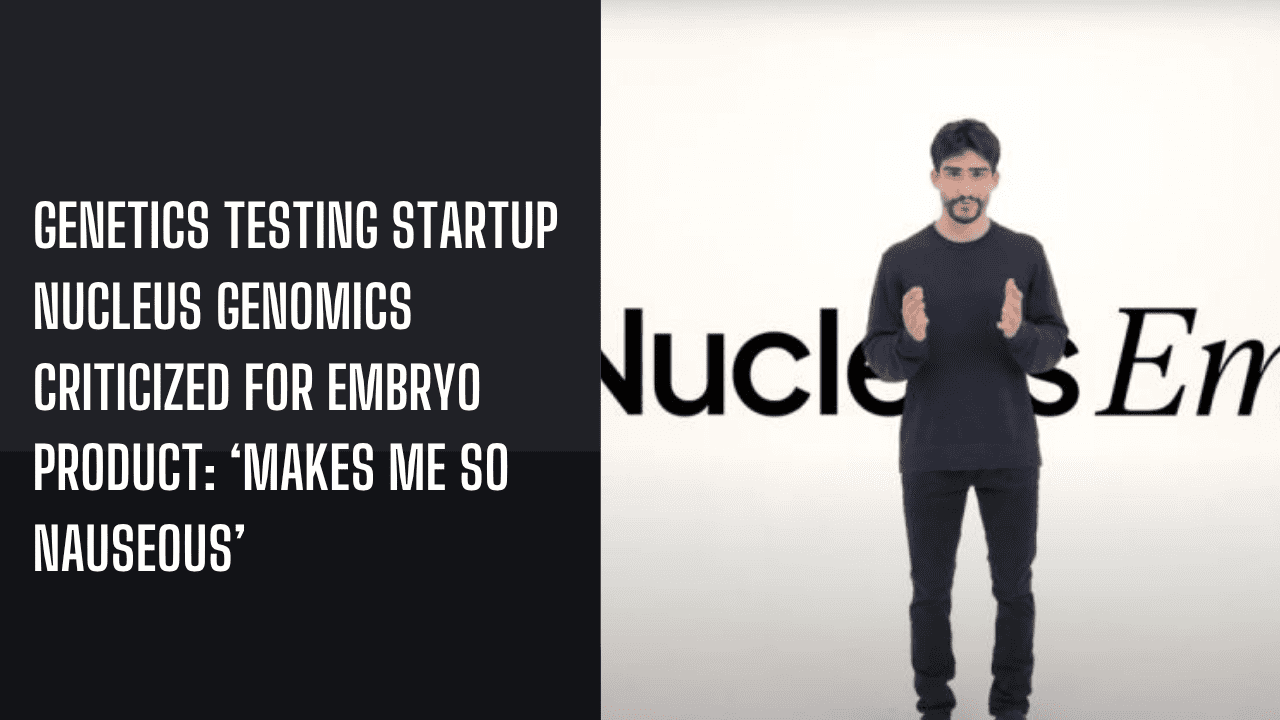
When 25-year-old Kian Sadeghi launched Nucleus Genomics in 2021, the startup had a clear mission: help patients understand their genetic risk for certain diseases.
But in the years since, it has steadily courted controversy with products that go well beyond traditional health insights — even claiming to correlate genetics with complex traits like IQ.
This week, the debate surrounding Nucleus reached fever pitch.
On Wednesday, the company announced a new offering called Nucleus Embryo with a bold tweet:
“Every parent wants to give their children more than they had. For the first time in human history, Nucleus adds a new tool to that commitment.”
Nucleus says this tool can test IVF embryos for far more than disease risk. In addition to screening for genes linked to illnesses like breast cancer, the company claims it can predict and display information about appearance — sex, height, hair color, eye color — and even complex traits like IQ, anxiety, and ADHD.
The company’s promotional video didn’t shy away from the implications. One screenshot shows a menu that allows parents to compare embryos, raising ethical questions about choosing — or discarding — potential future children based on their genetic profile.
A Step Beyond Traditional Testing
To be clear, genetic testing of embryos isn’t new. IVF specialists routinely screen for genes that can cause serious conditions like Down syndrome or cystic fibrosis, especially when parents are at high risk.
But what Nucleus is offering isn’t typical gene screening.
It’s using polygenic scores — a controversial method of calculating the probability of complex traits emerging based on a combination of genetic factors.
According to the National Human Genome Research Institute (NHGRI), polygenic risk scores don’t predict outcomes with certainty. Rather, they estimate the relative risk of developing a condition within a population.
For instance, having a BRCA1 mutation gives a person a clear, absolute risk of breast cancer (60%-80%). Polygenic scores don’t provide that level of precision. That’s why most doctors don’t use them to make individual clinical decisions.
“Polygenic risk scores are not yet routinely used by health professionals because there are no guidelines for practice and researchers are still improving how these scores are generated,” NHGRI explains.
Nucleus, however, stands by its methods. The company pointed to a 2018 research paper that validated polygenic risk scores for five diseases: coronary artery disease, atrial fibrillation, type 2 diabetes, inflammatory bowel disease, and breast cancer.
But using such scores to market embryo selection is something else entirely — and critics say it dangerously oversells what’s scientifically possible.
An Uproar on Social Media
The backlash was swift.
Nucleus’s tweet has now been viewed over 4 million times, with hundreds of comments expressing skepticism, anger, and outright disgust.
One prominent VC summed up the mood in a viral post:
“I was going to type something like Noah get the boat, but honestly the reality of this just makes me so nauseous.”
Not Their First Controversy
This isn’t the first time Nucleus has found itself in hot water. Earlier this year, the startup raised a $14 million Series A round backed by heavyweights including Founders Fund, Alexis Ohanian’s 776, and angel investors like Adrian Aoun, Brent Saunders, and Matteo Franceschetti.
Even before that, Sadeghi had drawn fire for launching Nucleus IQ, a product that claims to estimate how much a person’s intelligence is influenced by their genetics. Critics dismissed it as “bad science and big business.” Sadeghi defended the approach in a detailed public response.
But using such insights for adults is one thing. Offering IVF parents the ability to select embryos based on predicted intelligence, appearance, or mental health traits? Many feel that crosses an ethical line.
The Fine Print
At the moment, Nucleus isn’t conducting embryo testing directly with IVF labs, according to a Wall Street Journal report. Instead, it’s partnering with Genomic Prediction, which already works with IVF clinics.
A Genomic Prediction executive told the WSJ that although many parents ask for intelligence testing, the company does not provide it. However, parents who choose to can upload genetic data to Nucleus themselves.
In a launch video aimed at prospective parents, Sadeghi sought to frame this as part of a broader evolution in reproductive technology:
“Not that long ago, IVF sparked fear and the stigma of ‘test tube babies,’” he said. “What was once controversial is now an everyday practice. The same is true with genetic optimization. The technology is here — and it’s here to stay.”
The Bigger Question
But just because a technology can be used doesn’t mean it should be.
For now, the debate over designer babies — once the stuff of science fiction — is no longer hypothetical. It’s happening in real time. And startups like Nucleus Genomics are pushing society to confront some very uncomfortable questions about the future of human reproduction.