

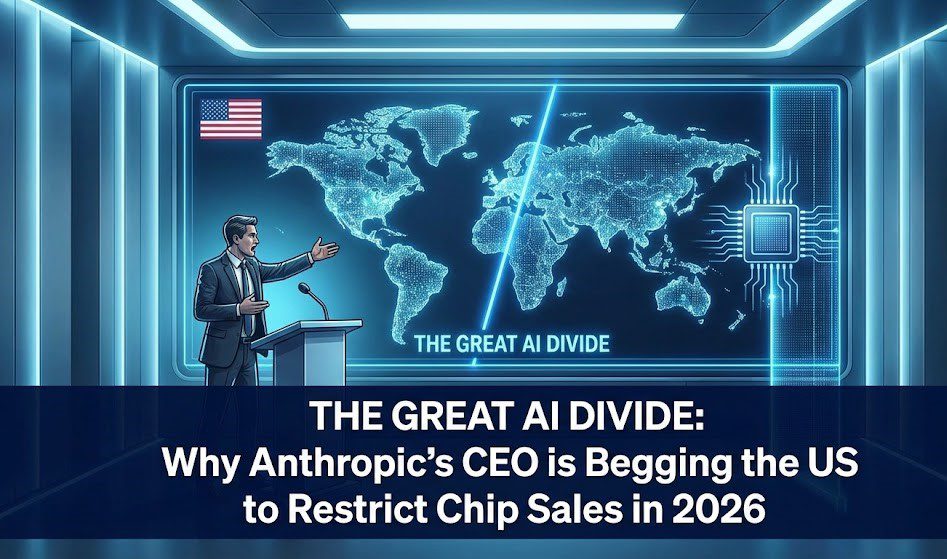
A massive geopolitical rift is tearing through the heart of Silicon Valley. Anthropic CEO Dario Amodei has once again drawn a hard line in the sand, publicly urging the US government to maintain strict export controls on advanced AI hardware.
In a recent, wide-ranging conversation on the Dwarkesh Patel podcast, Amodei laid out a stark case for why the US must keep its computational advantage locked down. His aggressive stance directly contradicts the intense lobbying efforts of Nvidia CEO Jensen Huang, who has spent months begging Washington to loosen restrictions and allow the sale of high-end chips to China.
As the battle over the global AI supply chain reaches a boiling point in 2026, here is why Amodei believes that selling AI chips to authoritarian regimes is a catastrophic national security risk.

1. AI Chips Are “Cognition,” Not Commodities
Amodei did not mince words regarding the fundamental nature of advanced semiconductors. He strongly argued that the US should not be building data centers in China or shipping top-tier chips across the Pacific.
To Amodei, the advanced GPUs powering today’s AI models are not mere trade commodities like smartphones or cars; they are “essentially cognition, essentially intelligence.” The Center for Strategic and International Studies (CSIS) has previously echoed similar sentiments, noting that whoever controls the hardware controls the ceiling of artificial intelligence capabilities. Amodei’s framing is blunt: the US should freely sell cures for diseases and help build pharmaceutical industries globally, but the data centers and the underlying compute must stay firmly out of authoritarian hands.
2. The Myth of AI “Mutually Assured Destruction”
At Davos last month, Amodei famously compared selling advanced chips to China to “selling nuclear weapons to North Korea and bragging that Boeing made the casings.” On the podcast, he took this analogy a terrifying step further.
If the US and China end up with equally powerful AI systems, Amodei warns the resulting standoff would be far more dangerous than historical nuclear deterrence.
- The Nuclear Contrast: With nuclear weapons, “Mutually Assured Destruction” keeps things relatively stable because neither side can win.
- The AI Threat: With artificial intelligence, two rival superpowers might each falsely believe their AI could outsmart the other in a direct confrontation.
- Cyber Dominance: Amodei raised the chilling prospect of offensive cyber dominance—a threshold where one nation’s AI could seamlessly penetrate and make every rival computer system transparent, paralyzing a nation’s infrastructure before a single shot is fired.
3. A Global Strategy to Outpace Digital Authoritarianism
Amodei reframed the entire export debate around something much bigger than Nvidia’s quarterly revenue. He predicts that the economic growth generated by AI will soon arrive almost “faster than we can take it.” The real challenge of the late 2020s will be distributing that value fairly while protecting global political freedom.
Rather than cutting developing nations out of the AI boom, Amodei pitched a highly strategic global expansion:
- Infrastructure in the Global South: He suggested aggressively building data centers in Africa and ensuring AI-driven industries, like biotechnology, take root outside of the West. The World Economic Forum (WEF) has actively advocated for this exact strategy to prevent a massive digital divide.
- The Individual Digital Shield: He even floated a theoretical scenario where AI tools could be designed to protect citizens inside authoritarian countries from their own governments’ surveillance—acting as an individualized digital shield against the rise of digital authoritarianism.
4. The Billion-Dollar Irony: Anthropic vs. Nvidia
What makes this philosophical clash so incredibly spicy is the financial web connecting the two companies. Nvidia has poured over $10 billion into Anthropic to secure its position in the foundational model race. Yet, Amodei continues to publicly torch Nvidia’s biggest geopolitical policy ask.
Jensen Huang has not taken this quietly. The Nvidia CEO has previously accused Amodei of pushing for draconian AI regulations simply because “regulatory capture” benefits Anthropic’s competitive market position. Huang has also taken direct shots at Amodei’s warnings regarding massive white-collar job losses, dismissing them as self-serving fear-mongering designed to sell Anthropic’s “safe” AI models.

Conclusion
The escalating feud between Dario Amodei and Jensen Huang has become the defining policy battle of the AI era. It is a fundamental clash between unbridled global capitalism and strict geopolitical security. While Nvidia views global chip sales as the ultimate driver of human technological progress, Anthropic views the restriction of these chips as the only way to prevent a catastrophic, AI-driven global conflict. Based on their recent public sparring, neither side has any intention of backing down.
Also Read : The Best Mirrorless Cameras to Buy in 2026: The Ultimate Buyer’s Guide
