

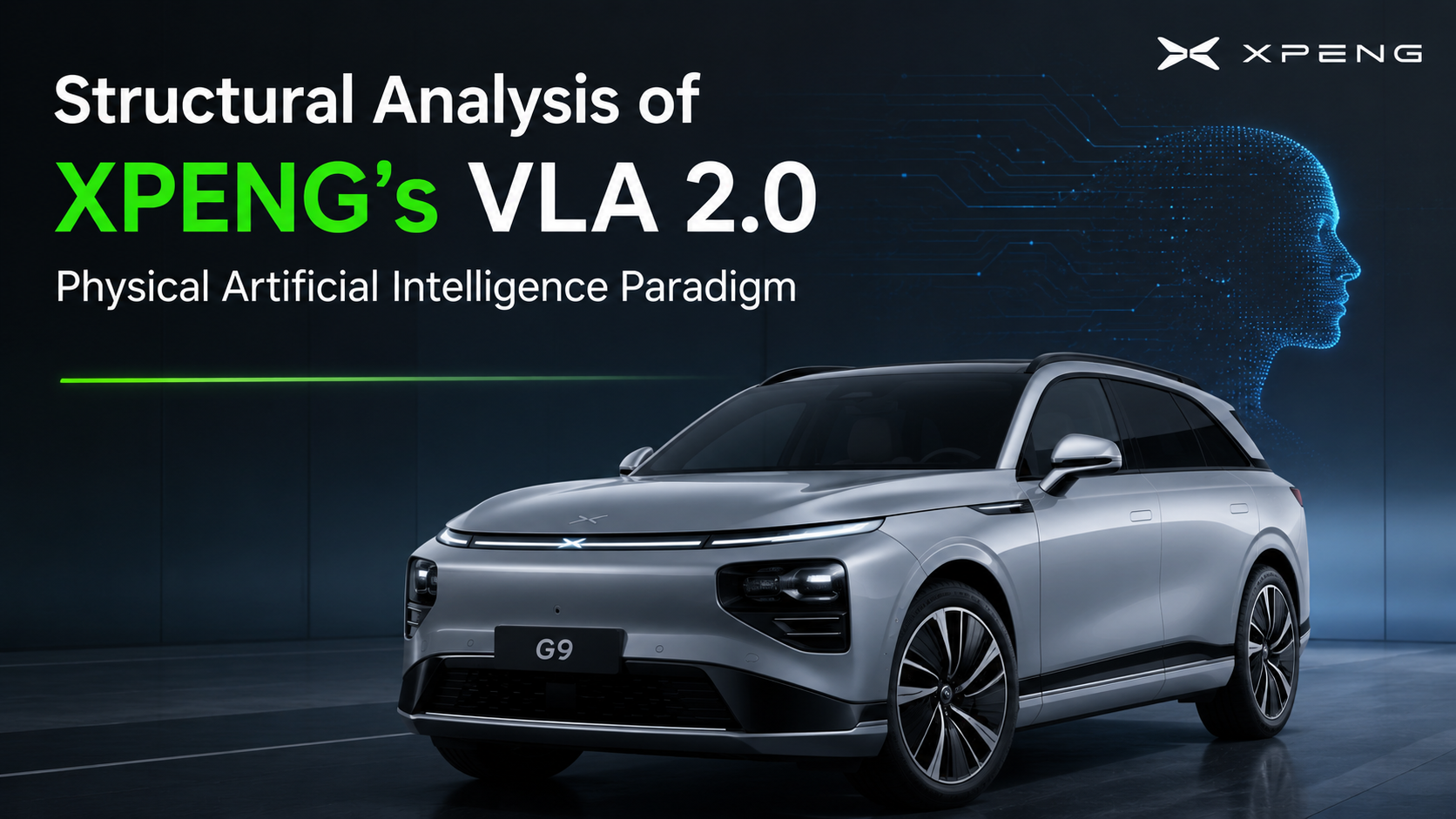
The global automotive sector is undergoing an architectural transition from traditional rule-based software pipelines to comprehensive end-to-end deep learning networks. This paradigm shift was solidified following EV manufacturer XPENG’s announced 2027 global deployment roadmap for its next-generation VLA 2.0 (Vision-Language-Action) autonomous driving architecture. Developed under the technical direction of Dr. Xianming Liu, head of XPENG’s General Intelligence Center, VLA 2.0 represents the first operational AI model in China demonstrating explicit Level 4 (L4) potential as defined by SAE International.
- Technical Mechanics: The Physical AI Paradigm Shift
- 1. Continuous, Non-Structured Signal Processing
- 2. Billion-Parameter Model Capacity
- 3. End-to-End Decision Generation
- Vision-Language-Action: Integrating Human Intent
- Autonomy Automation Hierarchy & Competitive Landscape
- Edge Compute Optimization and The Robotic Confluence
- Conclusion
By abandoning the legacy, sequential frameworks of traditional vehicle automation in favor of a singular, multimodal foundation model, the system bridges the historical gap between digital software interfaces and physical machine execution. This technical brief evaluates the structural mechanics of XPENG’s Vision-Language-Action model, its system-level data scaling advantages across highly complex driving environments, and the unification of foundation models across electric vehicles and humanoid robotics.
Technical Mechanics: The Physical AI Paradigm Shift
Traditional Advanced Driver Assistance Systems (ADAS)—including early iterations of XPENG’s Navigation Guided Pilot (NGP)—operate on a highly structured, sequential software stack divided into isolated compute nodes:
$$\text{Legacy Pipeline:}\quad [\text{Sensor Perception}] \longrightarrow [\text{Object Prediction}] \longrightarrow [\text{Path Planning}] \longrightarrow [\text{Actuator Control}]$$
In this traditional model, raw camera or LiDAR streams are processed to generate abstract data structures, such as bounding boxes surrounding detected obstacles. This abstraction introduces severe information loss. If an un-indexed or highly irregular hazard appears on the road—historically referred to in AI theory as an “unknown unknown” or corner case—the system fails to categorize the obstacle, breaking the sequential planning link and triggering critical system disengagements.
VLA 2.0 replaces this entire multi-layered stack with a single, massive neural network architecture optimized for Physical AI—the seamless integration of intelligence software with physical hardware designed to actively interact with the real world.
1. Continuous, Non-Structured Signal Processing
Unlike digital language models that process static text tokens, physical AI systems handle continuous, un-structured data streams with massive information loads. VLA 2.0 feeds raw, un-abstracted video frames from the vehicle’s onboard camera suite directly into the core neural net.
2. Billion-Parameter Model Capacity
By expanding the model’s internal capacity to a billion-parameter scale, the neural network acts as a unified semantic router. The model processes the visual world holistically, absorbing spatial geometry, environmental texture, and motion vectors simultaneously.
3. End-to-End Decision Generation
The model completely bypasses hand-coded driving logic rules. It matches real-time visual streams directly with real-world control signals (steering angles, braking pressure, torque distribution) using mathematical parameters learned from millions of hours of high-fidelity human driving datasets.
Vision-Language-Action: Integrating Human Intent
What elevates the VLA 2.0 framework beyond basic end-to-end neural steering is its multi-modal capacity to merge real-time vision processing with human language understanding.
The system handles direct, un-structured verbal instructions and correctly maps them against live visual environments to execute complex, multi-step actions. If a passenger dictates: “Pull over up ahead in front of the Starbucks so I can grab a coffee,” the network performs a real-time semantic search across its visual field to locate the brand’s sign, evaluates the curbside geometry for local parking regulations, determines a safe deceleration path, and executes a smooth parking sequence—all without needing pre-mapped route data or hard-coded rules.
Autonomy Automation Hierarchy & Competitive Landscape
To understand VLA 2.0’s structural positioning, it must be evaluated against global automotive standards and current market alternatives.
| SAE Automation Level | Technical Operating Threshold | Core System Limitations | XPENG VLA 2.0 Structural Realignment |
| Level 2 (L2) Partial | Driver must continuously supervise the system; handles basic lane centering and adaptive pacing. | Prone to misleading naming tropes (e.g., Tesla FSD Supervised/Assisted Driving); holds no legal liability. | Generational Leap: Moves away from supervised assist loops into a self-contained, predictive physical model. |
| Level 3 (L3) Conditional | Vehicle handles all driving tasks under narrow, highly restricted geofenced scenarios. | Highly fragile; fails instantly outside specific freeway networks or during poor weather conditions. | Mapless Independence: Eliminates the need for hd-map road blueprints; reads live road conditions dynamically. |
| Level 4 (L4) High | The vehicle can manage all critical safety functions inside a defined operational design domain. | High R&D cost; historically required expensive, un-scalable LiDAR setups and continuous cloud computing links. | The Billion-Parameter Edge: Executes complex, end-to-end L4 actions entirely locally on vehicle hardware. |
Edge Compute Optimization and The Robotic Confluence
- Total Cloud Disconnection (Local Edge Autonomy): A major structural safeguard baked into the VLA 2.0 architecture is its absolute independence from remote cloud servers. All neural model data inference, multi-camera processing loops, and text-to-action transformations are executed entirely locally on the vehicle’s onboard computing hardware. This zero-cloud framework guarantees that the vehicle’s tight latency windows remain uncompromised by cellular signal drops or remote server outages, while ensuring absolute personal data privacy by keeping user habits locked locally inside the vehicle chassis.
- The Chinese Corner-Case Data Advantage: While Tesla and XPENG are driving along similar first-principles trajectories—training unified neural networks to eliminate rigid, hand-coded driving rules—XPENG holds a distinct advantage in model optimization due to the sheer density of its training environment. Operating across major Chinese urban centers exposes the model to a constant influx of high-complexity corner cases, including aggressive scooter arrays, unstructured pedestrian crossings, and non-standard rural roads. This dense, chaotic data layer trains the model to understand risk organically, allowing it to dynamically adjust maximum vehicle speeds during inclement weather or heavy traffic based on live human behavior trends rather than fixed map data.
- Humanoid Robotics Transferability: Because VLA 2.0 functions as a physical AI foundation model rather than a narrow automotive steering program, its underlying R&D architectures are directly transferable to humanoid robotics. The core challenges of automated systems—reconstructing the 3D world from vision sensors, predicting moving obstacles, understanding human intent, and translating text into precise physical motor controls—are nearly identical whether managing a seven-seat EV like the X9 or controlling a bipedal mechanical frame like XPENG’s lifelike IRON humanoid robot. This shared foundation maximizes the efficiency of ongoing R&D budgets, turning advancements in vehicle automation into immediate breakthroughs for general-purpose robotic labor.
Conclusion
The definitive automotive engineering verdict on XPENG’s VLA 2.0 rollout confirms that the dream of true Level 4 autonomy cannot be achieved by stacking more rules onto legacy software structures. By completely redesigning the automation loop around a billion-parameter physical AI model that maps vision inputs directly to real-time motor commands, XPENG has established a highly scalable path toward fully driverless transport, a milestone covered closely across tech and industry media by Mashable.
While the system still requires occasional human intervention during its current optimization phase, its mapless independence, multi-modal intent tracking, and local edge processing confirm that the vehicles of the next decade will function less like traditional mechanical cars and more like highly advanced, context-aware physical robots built to navigate our world safely alongside us.
