

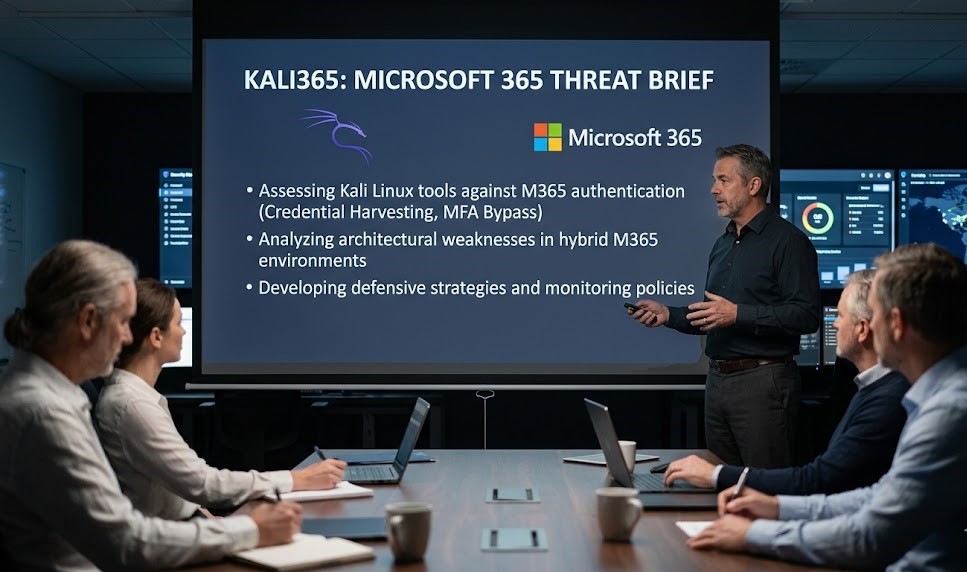
In late May 2026, the Federal Bureau of Investigation (FBI) issued a critical alert regarding “Kali365,” a sophisticated new phishing platform targeting Microsoft 365 enterprise environments. Initially detected in April, this tool allows attackers to hijack Outlook, Teams, and OneDrive sessions without ever needing a user’s password. This intelligence brief deconstructs the attack methodology, the platform’s reliance on artificial intelligence, and the strategic mitigation protocols necessary to secure corporate cloud infrastructure.

Technical Mechanics: OAuth Device Code Exploitation
The Kali365 campaign represents a dangerous evolution in account takeover tactics, shifting the focus from credential harvesting to session token hijacking.
- The MFA Bypass: The attack initiates with an AI-generated phishing lure, typically impersonating a trusted document-sharing service. The email instructs the victim to visit a legitimate Microsoft verification page and input a provided device code. By doing so, the victim unwittingly authorizes the attacker’s device, exploiting the OAuth device code flow to bypass standard passwords and Multi-Factor Authentication (MFA).
- AI and Real-Time Tracking: Kali365 significantly lowers the technical barrier for cybercriminals. The platform automates the creation of highly convincing lures and allows attackers to target and track individual victims in real-time as they interact with the fraudulent prompts.
- Telegram Distribution: The platform is primarily distributed and operated via the messaging app Telegram, allowing threat actors to rapidly deploy the tool and communicate within encrypted underground ecosystems.
Strategic Deployment: Enterprise Threat & Mitigation Matrix
The FBI and Microsoft have outlined specific defense protocols to combat the unique threat posed by the Kali365 architecture.
| Operational Domain | Attack Methodology | Recommended Mitigation Strategy |
| Initial Intrusion | Deployment of AI-generated phishing emails impersonating trusted file-sharing services. | User education to identify lures; prohibiting the opening of unexpected files from unknown senders. |
| Authentication Bypass | Tricking victims into entering authorization codes on genuine Microsoft portals to capture tokens. | Implementation of strict Conditional Access policies to explicitly block all users from device code flows (with limited emergency exceptions). |
| Lateral Movement | Accessing Outlook, Teams, and OneDrive to establish persistence and exfiltrate data. | Auditing current access logs to verify who currently holds code flow usage rights, and blocking PC-to-mobile authentication transfers. |
Structural Vulnerabilities and Strategic Limitations
- The Phishing-as-a-Service Threat: Kali365 operates as a highly scalable phishing-as-a-service (PaaS) model. Because the platform automates the complex parts of token theft, unskilled attackers can launch enterprise-grade breaches with minimal technical knowledge.
- Exploiting Trust Indicators: Traditional email security filters often fail to block Kali365 attacks because the user is directed to a genuine, secure Microsoft URL to enter the code. The attack relies entirely on social engineering and exploiting the user’s inherent trust in official corporate login pages.
- Configuration Gaps: The primary defense against this attack requires proactive administrative configuration. Organizations that rely solely on out-of-the-box settings without actively restricting device code flows leave their authentication architecture highly vulnerable to token interception.

Conclusion
The strategic verdict for mid-2026 is that traditional multi-factor authentication (MFA) is no longer a foolproof shield against advanced token-theft platforms like Kali365. Cybercriminals have successfully engineered methods to steal the digital keys to the Microsoft 365 ecosystem without ever touching a password. To maintain operational security, enterprise IT departments must immediately audit their cloud environments, implement rigorous conditional access restrictions, and actively disrupt the device code flows that these attackers rely upon.
Also Read : Technology Architecture: Week 21 Mobile & Audio Market Brief
