

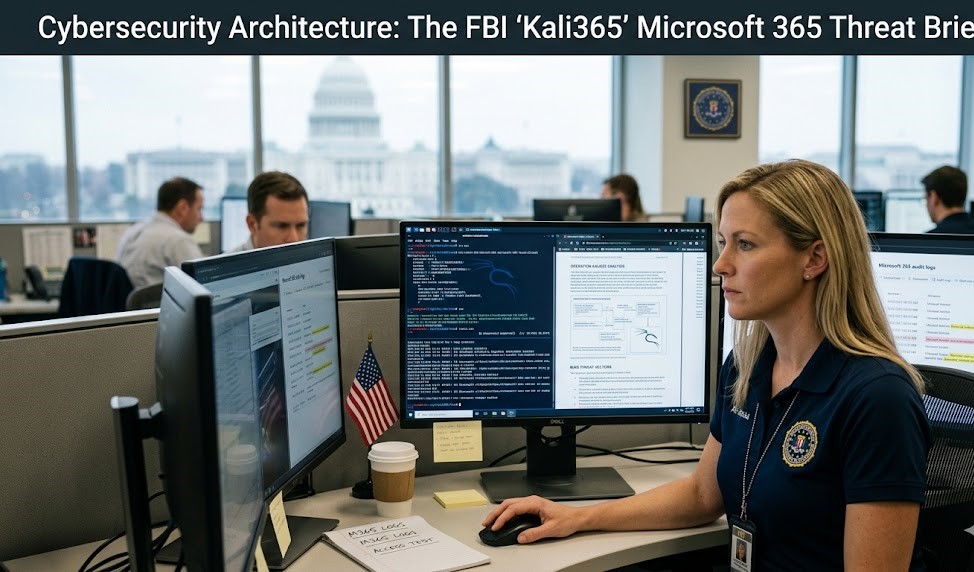
In late May 2026, the Federal Bureau of Investigation’s Internet Crime Complaint Center (IC3) issued a severe alert regarding “Kali365,” a rapidly proliferating cyber threat targeting enterprise Microsoft 365 environments. This highly sophisticated campaign specifically circumvents traditional Multi-Factor Authentication (MFA) to compromise Outlook, Teams, and OneDrive accounts without requiring user passwords. This intelligence brief deconstructs the attack vector, the mechanics of OAuth token theft, and the strategic mitigation protocols necessary for enterprise security.

Technical Mechanics: OAuth Device Code Exploitation
The Kali365 campaign represents a critical evolution in phishing methodology, shifting the focus from credential harvesting to session hijacking.
- The MFA Bypass: Unlike traditional attacks that attempt to steal passwords, Kali365 tricks victims into authenticating malicious applications by intercepting OAuth device codes. These digital keys are designed to allow applications to access data without exposing the user’s password.
- The Infiltration Vector: By stealing these valid OAuth tokens, cybercriminals can silently bypass MFA protocols. The Microsoft ecosystem registers the login as a legitimate, authenticated session, granting the attacker immediate access.
- Persistent Access: Once the token is secured, attackers gain unfettered entry into the user’s entire Microsoft 365 ecosystem. This allows them to establish persistence and move laterally through a corporate network without triggering standard password-reset alerts or secondary MFA prompts.
Strategic Deployment: Enterprise Threat Matrix
The FBI’s warning highlights the severe consequences of a successful Kali365 breach, as attackers utilize the compromised accounts to launch secondary, highly damaging operations.
| Operational Domain | Target Focus | Malicious Objective |
| Microsoft Outlook | Corporate Communications | Business Email Compromise (BEC), wire fraud, and the distribution of internal phishing links. |
| Microsoft OneDrive | Cloud Storage Infrastructure | Mass data exfiltration, intellectual property theft, and extortion leverage. |
| Microsoft Teams | Internal Collaboration | Social engineering against co-workers and the silent deployment of ransomware payloads across the network. |
| Defense Protocol | Conditional Access Policies | The FBI recommends implementing strict access controls (e.g., geofencing, IP whitelisting) to block unauthorized token usage. |
Structural Vulnerabilities and Strategic Limitations
- The Illusion of Basic MFA Security: Organizations over-relying on standard Multi-Factor Authentication are highly vulnerable to this vector. Kali365 proves that if the authentication token itself is intercepted and stolen, the underlying password and the secondary MFA prompt are rendered entirely obsolete.
- Detection Friction: Because the attackers use valid OAuth tokens to access the systems, their initial entry often blends in seamlessly with legitimate user activity. This makes intrusion detection exceptionally difficult for standard, out-of-the-box security software.
- Conditional Access Dependency: The FBI’s primary recommended defense—implementing Conditional Access policies (such as restricting logins to specific IP ranges or compliant corporate devices)—requires advanced Microsoft licensing (like Entra ID Premium) and complex IT configuration. Many small-to-medium businesses (SMBs) lack the budget or technical expertise to properly deploy these safeguards.

Conclusion
The strategic verdict for enterprise cybersecurity in mid-2026 is that traditional password and basic MFA defenses are no longer sufficient against advanced token-theft campaigns like Kali365. The FBI’s urgent warning highlights a critical shift in attacker methodology: stealing the “keys” rather than trying to pick the lock. Organizations utilizing Microsoft 365 must immediately pivot to zero-trust architectures and enforce strict Conditional Access policies to secure their cloud environments against unauthorized device registration and catastrophic data theft.
Also Read : Technology Architecture: Week 21 Mobile & Audio Market Brief
