


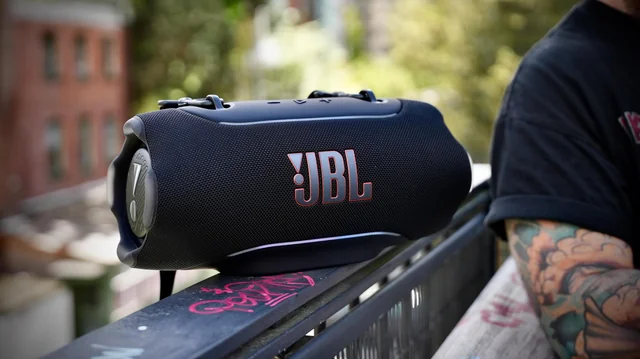
The portable audio sector is experiencing an aggressive shift toward high-yield, durable party speakers capable of outputting massive volume without sacrificing fidelity. Released in April 2026 for $399.95, the JBL Xtreme 5 represents a substantial architectural upgrade over its predecessor. Evaluated against the broader market of premium Bluetooth speaker systems, the Xtreme 5 justifies its hefty price tag by delivering 130W of thunderous power, edge lighting, and lossless USB-C audio passthrough. This intelligence brief deconstructs the audio mechanics, competitive positioning, and hardware vulnerabilities of JBL’s latest heavyweight portable speaker.

Technical Mechanics: Audio Architecture & Connectivity
Transitioning a portable speaker into a primary party hub requires significant internal amplification and modern connectivity protocols to ensure lossless playback.
- Acoustic Transducer Load: The Xtreme 5 generates its commanding volume through a heavily upgraded driver array. When connected to AC power, the system deploys a single 90W woofer alongside dual 20W tweeters. This is a massive 30W bass increase over the older Xtreme 4, delivering regimented, earth-shaking low-end frequencies that do not muddy the articulate mid and treble ranges.
- Lossless USB-C Integration: Moving beyond standard Bluetooth compression, the Xtreme 5 integrates a multi-functional USB-C port. This allows for direct wired audio passthrough for hi-res, lossless playback. Additionally, this port functions as a power bank, allowing the massive internal battery to reverse-charge mobile devices in the field.
- Algorithmic Customization & Auracast: The speaker is fully integrated with the JBL Portable companion app, which allows users to manipulate a seven-band equalizer and customize the newly integrated edge-lighting effects. Furthermore, the hardware utilizes Auracast wireless technology, permitting seamless multi-speaker pairing to expand the acoustic footprint across large physical spaces.
Strategic Deployment Matrix
Understanding the Xtreme 5’s market value requires comparing its specific hardware footprint and endurance against the primary competitors in the high-end portable audio sector.
| Audio System | Tactical Hardware Profile | Strategic Market Utility |
|---|---|---|
| JBL Xtreme 5 | 130W output; IP68 rating; 24-hour battery; 6.4lbs. | The ultimate outdoor party speaker, optimizing massive bass, durability, and visual light synchronization. |
| Bose SoundLink Max | Premium transducer array; IP67 rating; 20-hour battery; 4.7lbs. | A lighter, stylish alternative prioritizing refined, balanced audio over pure aggressive volume. |
| Marshall Kilburn III | 50W output; IP54 rating; 50-hour battery; 6.2lbs. | A retro-styled amplifier alternative offering unmatched battery endurance for multi-day deployments. |
Structural Vulnerabilities and Systemic Limitations
- Physical Bulk and Transport Friction: The primary structural vulnerability of the Xtreme 5 is its sheer physical footprint. Weighing in at 6.4lbs (2.9kg), it is considerably heftier than both its predecessor and immediate rivals like the Bose SoundLink Max. While JBL mitigates this with an included shoulder strap, the sheer mass limits its utility for casual, lightweight travel.
- Battery Endurance Ceilings: Despite the increased size, the Xtreme 5 tops out at 24 hours of standard playback, or 28 hours utilizing the audio-compressing “PlayTime Boost” mode. While respectable, it falls drastically short of class leaders like the Marshall Kilburn III portable amplifier, which delivers up to 50 hours of continuous operation.
- Lack of Telephony Hardware: In a deliberate cost and design omission, the Xtreme 5 does not feature a built-in microphone array. This prevents the unit from being utilized as a speakerphone for hands-free calls. While its robust IP68 waterproof and dustproof certification makes it virtually indestructible in pool or beach environments, the lack of a microphone limits its utility as a centralized communication hub in home or office settings.
Conclusion
The strategic verdict on the JBL Xtreme 5 is that it operates as a brute-force acoustic asset that successfully balances extreme power with refined audio clarity. By aggressively upgrading the woofer output and integrating modern features like edge lighting and lossless USB-C audio, JBL has created an uncompromising outdoor party speaker. While its hefty 6.4lb frame and lack of speakerphone capabilities represent slight limitations, its mesmerizing bass response and sheer durability solidify its position as the premier choice for high-volume, rugged audio deployment in 2026.
