

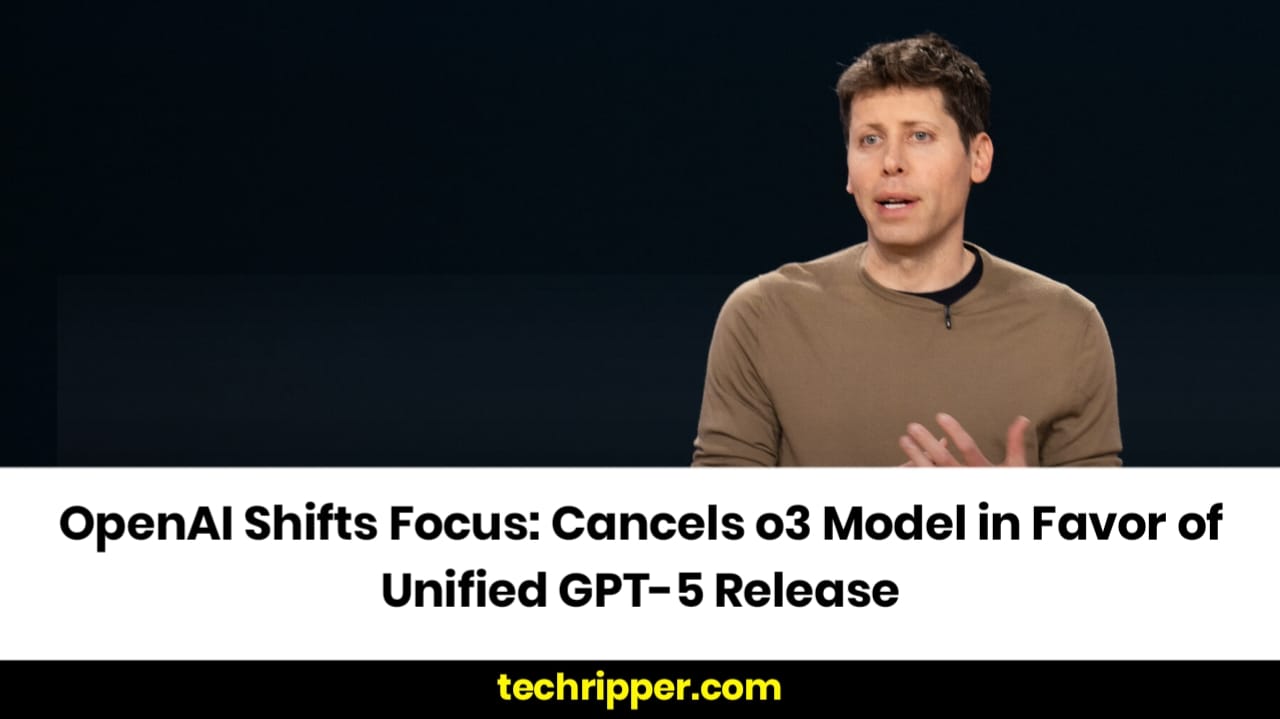
In a surprising move, OpenAI has decided to cancel the release of its much-anticipated o3 AI model, opting instead for a more streamlined and unified approach with the upcoming GPT-5. This decision was announced by CEO Sam Altman in a post on X (formerly Twitter), where he revealed that GPT-5 will integrate a wide range of OpenAI’s technologies, including advancements from the o3 project, into a single cohesive platform.
The announcement marks a significant shift in OpenAI’s strategy. Originally slated for release in early 2025, o3 was expected to be the company’s next major milestone in AI development. However, according to Altman, OpenAI is now prioritizing simplicity and usability over fragmented product offerings.
“We want to do a better job of sharing our intended roadmap, and a much better job simplifying our product offerings,” Altman wrote. “We want AI to ‘just work’ for you; we realize how complicated our model and product offerings have gotten.”
What to Expect from GPT-5
Altman outlined several key features of GPT-5, which is expected to launch in the coming months:
- Unified Intelligence: GPT-5 will combine various tools and capabilities, such as voice interaction, advanced search, deep research, and more, into a single system.
- Tiered Subscription Access:
- Standard intelligence settings will be available to all users, subject to “abuse thresholds.”
- ChatGPT Plus subscribers will gain access to a higher level of intelligence.
- ChatGPT Pro users will unlock an even more advanced tier of performance.
- Enhanced Reliability: By integrating reasoning models—like those pioneered with o1—GPT-5 aims to deliver improved accuracy and reliability across tasks.
Altman emphasized that one of OpenAI’s top goals is to create systems capable of handling a broad spectrum of tasks while knowing when to “think deeply” or act quickly.
The Roadmap Before GPT-5
Before the rollout of GPT-5, OpenAI plans to introduce GPT-4.5 , codenamed Orion , within the next few weeks. According to Altman, Orion represents the company’s last “non-chain-of-thought” model—a type of AI less adept at complex problem-solving compared to reasoning models like o1 and o3.
However, reports suggest that Orion has faced challenges during development. Independent sources, including Bloomberg and The Wall Street Journal, indicate that it shows only modest improvements over its predecessor, GPT-4o. These setbacks may have influenced OpenAI’s decision to accelerate the transition toward reasoning models and unify their offerings under GPT-5.
The Rise of Reasoning Models
Reasoning models, first popularized by OpenAI’s o1, are designed to self-correct through internal fact-checking processes. While this results in slightly longer response times, these models demonstrate greater reliability and capability, particularly in domains like mathematics and physics.
OpenAI isn’t alone in advancing this trend. Recently, Chinese AI lab DeepSeek made waves with its R1 model, which matches o1’s performance on several benchmarks. Unlike o1, however, R1 is open-source, allowing developers to freely download and modify it. In response to growing competition, Altman acknowledged that OpenAI’s technological lead has narrowed and hinted at accelerating future releases to stay competitive.
Why Cancel o3?
The cancellation of o3 reflects OpenAI’s desire to simplify its product lineup and focus on delivering a seamless user experience. Instead of releasing multiple standalone models, the company appears committed to consolidating its innovations into a unified platform. This approach aligns with Altman’s vision of creating “magic unified intelligence” that eliminates the need for users to navigate between different models via ChatGPT’s current model picker.
Looking Ahead
As OpenAI prepares for the launch of GPT-4.5 and eventually GPT-5, the AI landscape continues to evolve rapidly. With competitors like DeepSeek pushing boundaries in open-source AI, OpenAI faces mounting pressure to maintain its leadership position. Whether GPT-5 lives up to expectations remains to be seen, but one thing is clear: OpenAI is betting big on unification and accessibility as the keys to its next phase of growth.
For now, fans of OpenAI’s technology will have to wait patiently for GPT-5 to arrive—but if Altman’s promises hold true, it could redefine what we expect from artificial intelligence.
Also Read : Nirav Tolia Turns to AI to Keep Nextdoor Neighborly
