

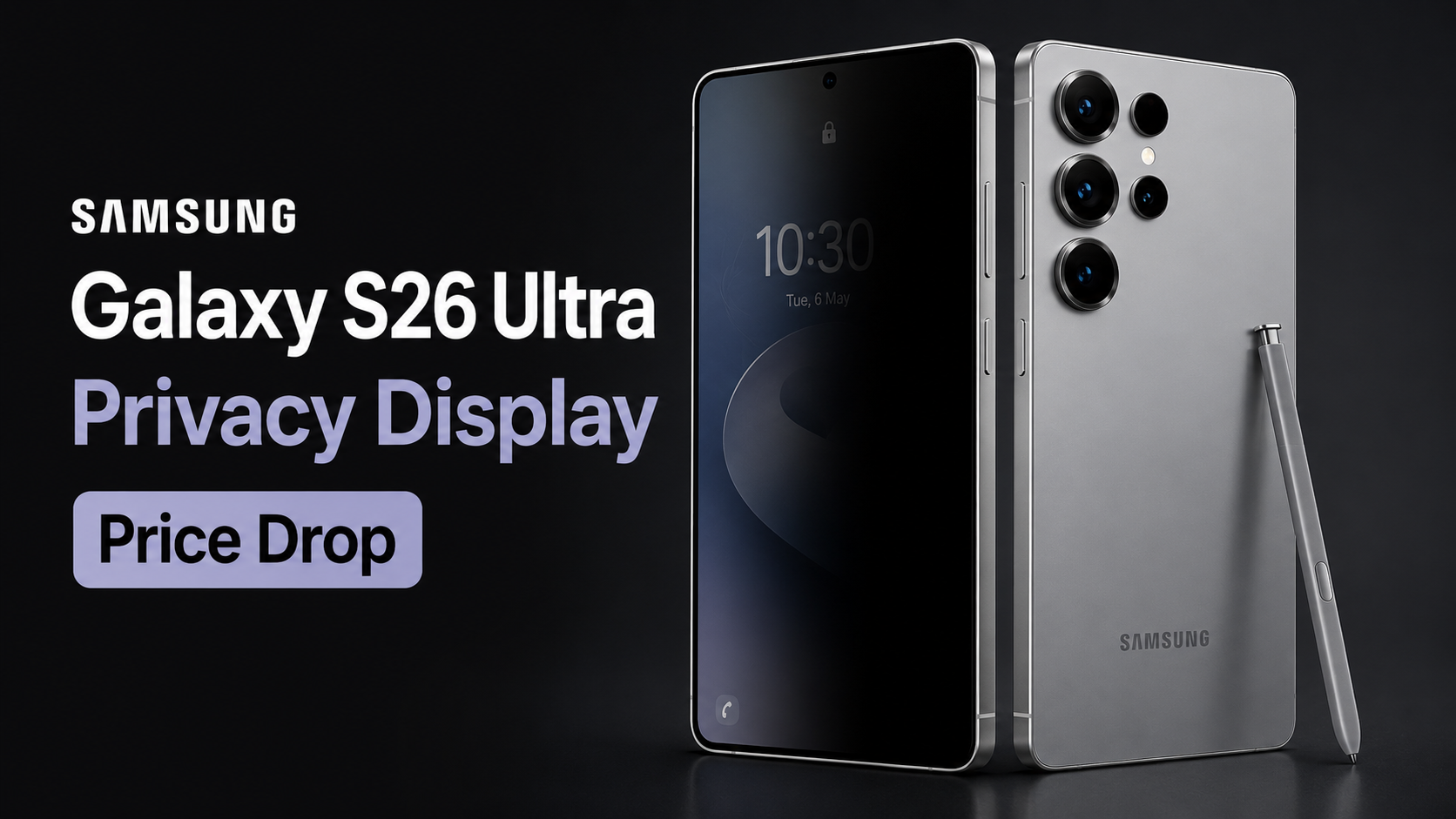
The early summer smartphone market has experienced a significant pricing shakeup. Just months after their winter launch, Samsung’s flagship Galaxy S26 series has hit its lowest price point to date, driven by an aggressive e-commerce push ahead of Amazon’s Prime Day. With temporary discounts slicing up to $200 off the retail tags, the base Galaxy S26 has dropped to $800, the S26+ to $900, and the top-tier S26 Ultra to $1,100.
While the hardware updates across the base and Plus models remain largely iterative—retaining the preceding generation’s battery capacities, chassis dimensions, and silicon footprints—the line’s true engineering leap is consolidated within its premium tier. The Galaxy S26 Ultra debuts the world’s first hardware-level, panel-integrated Privacy Display, an innovation that systematically eliminates the need for polarizing third-party physical films. This technical brief evaluates the underlying pixel-level mechanics of Samsung’s active privacy shielding, its software implementation, and the market economics driving this early mid-cycle hardware discount.
Technical Mechanics: Flex Magic Pixel OLED Architecture
Traditional privacy solutions have long relied on passive, external accessories. Sticky multi-layered plastic screen protectors use physical micro-louvers to block light outside a narrow 30-degree viewing cone. However, these third-party filters introduce severe structural trade-offs: they permanently degrade peak brightness by up to 30%, introduce a distracting moiré pattern, and cause irreversible color shifting even when the user is viewing the screen head-on.
Samsung Display bypasses these limitations by baking the privacy mechanism directly into the Dynamic LTPO AMOLED 2X panel during fabrication. Developed under the technical nomenclature Flex Magic Pixel, the display architecture alters how individual organic light-emitting diodes disperse light across the sub-pixel grid.
1. Active Light Polarization Control
Rather than placing a fixed physical layer over the glass, the Flex Magic Pixel panel features native, directional sub-pixel structuring. When the feature is turned off, the OLED panel emits a standard, wide-dispersion Lambertian light pattern, providing broad viewing angles up to 178 degrees for sharing media with groups.
When the user activates the Privacy Display via the system software, the display driver alters the current flow and configuration across the micro-polarized light elements. This forces the sub-pixels to actively compress their horizontal emission angles, projecting the light beams straight forward in a highly directional vector.
2. Angular Visual Degradation
Independent optical benchmarking reveals that when Privacy Display is engaged, peripheral light transmission drops dramatically:
$$\text{Peripheral Luminance Reduction} = \left( 1 – \frac{\text{Luminance at } 30^{\circ}\text{ Off-Axis (Active)}}{\text{Luminance at } 30^{\circ}\text{ Off-Axis (Standard)}} \right) \times 100 \approx 99.1\%$$
From a side perspective of 30 to 45 degrees—the typical angle for shoulder-surfing in a crowded subway car or public cafe—the display appears entirely black or severely dimmed. Meanwhile, the primary user looking at the screen straight-on retains full access to the display’s maximum capabilities: a sharp QHD+ resolution, rich color accuracy, and up to 2,600 nits of peak brightness backed by anti-reflective Corning Gorilla Armor 2.
Software Integration: Contextual Verification Frameworks
What distinguishes this hardware implementation from passive screen protectors is its tight integration with Samsung’s One UI operating system. Rather than forcing a permanent privacy filter on the entire user experience, the system leverages a dedicated software controller to toggle the directional pixel mode based on real-time application context.
- System-Level Credential Shielding: The display framework links directly to internal password verification protocols. The moment a user interacts with a secure password field, an alpha-numeric PIN box, or a pattern unlock mesh on the lock screen or within Secure Folder, the display driver instantly forces the pixels into narrow-angle emission. This automated protection prevents over-the-shoulder lookups in public spaces.
- Granular Per-App Targeting: Within the system display settings or via a quick-panel toggle, users can map the Privacy Display feature to specific applications. For example, the screen can run in wide-angle mode for open apps like YouTube or TikTok, but the moment a banking app, email client, or private messenger like WhatsApp or Telegram is launched, the screen automatically shifts down to protect confidential personal data.
- Partial Screen Masking: Because the polarization is handled at the panel level, the display controller can apply narrow-angle masking to specific screen regions. If a sensitive notification pop-up or a two-factor authentication (2FA) one-time passcode (OTP) appears on the screen, the display can selectively dim off-angle visibility only over the notification banner, leaving the rest of the app layout unaffected.
Flagship Specification Matrix
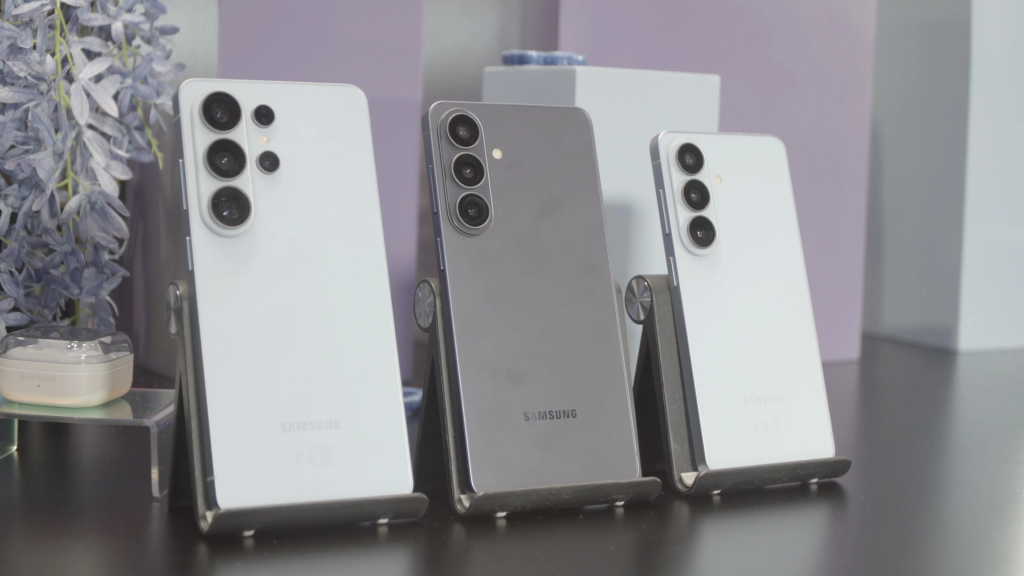
While the Privacy Display serves as the centerpiece of the Ultra tier, the entire S26 lineup has received minor performance and memory re-allocations to match modern software processing loads.
| Hardware Specification | Galaxy S26 Base | Galaxy S26+ Plus | Galaxy S26 Ultra |
| Physical Display Size | 6.3-inch Flat Display | 6.7-inch Flat Display | 6.9-inch Structured Display |
| Native Panel Resolution | 2340 × 1080 (FHD+) | 3120 × 1440 (QHD+) | 3120 × 1440 (QHD+) |
| Privacy Display Support | No (Standard Wide-Angle) | No (Standard Wide-Angle) | Yes (Flex Magic Pixel Panel) |
| Maximum Memory Allocation | 8GB / 12GB LPDDR5X | 12GB LPDDR5X | Up to 16GB LPDDR5X (1TB Tier) |
| Front Protection Layer | Gorilla Glass Victus 3 | Gorilla Glass Victus 3 | Corning Gorilla Armor 2 (Anti-Reflective) |
| Prime Day Promo Price | $800 (Down from $900) | $900 (Down from $1,000) | $1,100 (Down from $1,300) |
Market Dynamics: Decoding Early Flagship Discounts
The appearance of steep, $100 to $200 price cuts just months after a major smartphone release highlights a significant shift in corporate marketing strategies. Historically, premium mobile electronics held their full retail pricing until late in their product lifecycle. However, modern consumer tech sales patterns have forced brands to rethink their strategies:
- The Symmetrical Naming Strategy Shift: Samsung’s move to match the model number directly to the release year—making 2026’s flagship the S26 series—simplifies consumer tracking compared to Apple’s abstract, continuing numbers. However, this explicit calendar link creates an aggressive shelf-life expiration effect. Because consumers know the phone will be succeeded the moment the calendar flips, manufacturers face intense pressure to maximize sales volume during the first six months of the year.
- E-Commerce Promotional Alignment: Major tech brands routinely leverage massive, third-party sales campaigns like Amazon’s early Prime Day push to drum up mid-cycle sales without officially lowering their own direct-to-consumer store prices. This allows Samsung to clear warehouse stock and counter seasonal dips while keeping its official premium pricing intact.
- The Hardware Tiering Trap: By limiting the groundbreaking Privacy Display technology exclusively to the $1,300 Ultra model, the base S26 and S26+ models were left with incredibly minor upgrades compared to the older S25 family. Because savvy consumers recognize that the base models offer nearly identical processors and batteries to last year’s hardware, demand naturally slumps. These early, aggressive price drops serve as a vital financial correction to convince hesitant upgraders to pull the trigger.
Conclusion
The definitive hardware verdict on Samsung’s early 2026 flagship promotions confirms that while the base Galaxy S26 and S26+ offer solid, dependable value at their newly discounted $800 and $900 price points, they remain safe, incremental upgrades. True innovation is concentrated entirely within the Galaxy S26 Ultra. By deploying the world’s first hardware-integrated Flex Magic Pixel panel, Samsung has successfully solved a major public privacy issue at the pixel level, bypassing the messy, brightness-killing limitations of physical plastic screen films.
As tracked by tech news platforms like Gizmodo, the temporary $200 discount brings the Ultra down to a much more accessible $1,100. This early discount creates an exceptional buying window for mobile professionals, commuters, and privacy-focused users looking to secure cutting-edge, hardware-level display security at a rare mid-year discount.
Also Read : VRChat Says Reported Data Breach Never Happened
